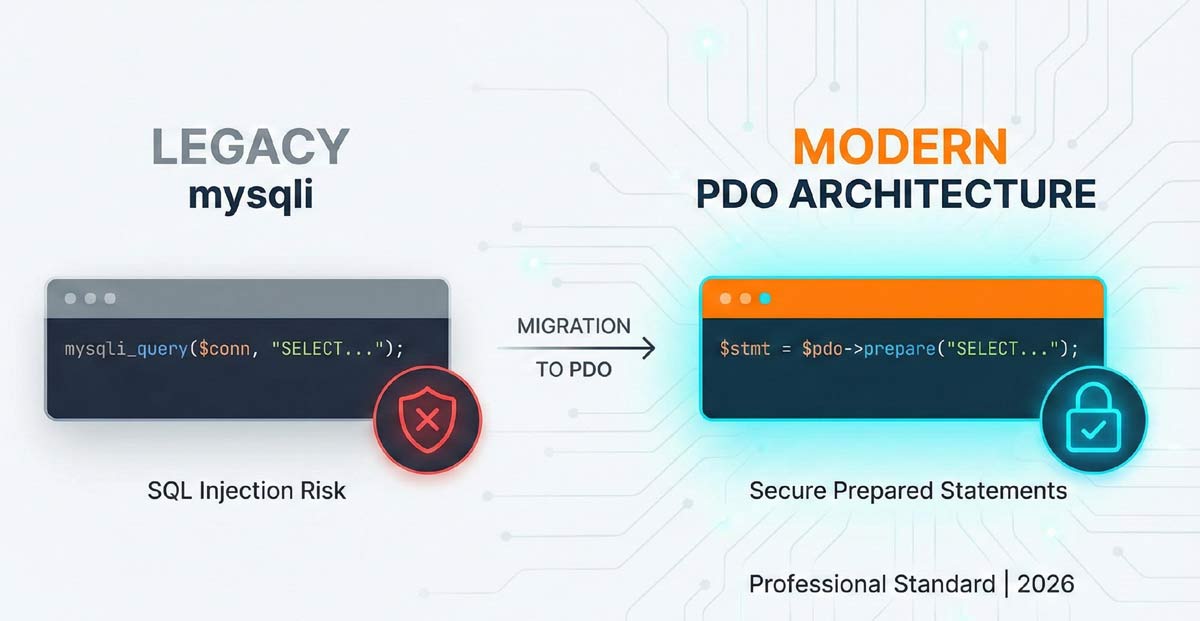
Beyond mysqli: Why PDO is the Only Professional Choice in 2026
In 2026, there is no valid technical reason for a modern PHP website to still rely on raw mysqli_* functions or string-built SQL queries.
Yet, many production environments—including high-traffic systems—continue to carry this legacy burden. This isn't just a matter of "new vs. old"; it is a matter of architectural integrity and security.
If you are maintaining a codebase with 10+ years of history, you likely have thousands of lines of mysqli code. This article explains why PDO (PHP Data Objects) must be your default database layer and how to navigate the migration without risking business continuity.
1. The State of PHP Database Access in 2026
The PHP ecosystem has reached a level of maturity that demands professional-grade patterns. With the release of PHP 8.x, the language has moved toward strict typing and robust error handling. In this landscape:
- Security Expectations: SQL injection is no longer viewed as a "mistake"—it is viewed as a critical failure in engineering oversight.
- Typed Code: Modern architectures rely on objects and classes, not loose arrays and global connection strings.
Yet, many legacy applications still use dangerous patterns like these:
// Dangerous: Direct variable injection
mysqli_query($conn, "SELECT * FROM users WHERE id = $id");

// Worse: Manual string concatenation
$query = "SELECT * FROM users WHERE email = '" . $email . "'";
2. What Is PDO and Why Does It Matter?
PDO is not just "another way to connect." It is a database abstraction layer built into PHP core. It acts as a consistent interface, meaning the way you talk to a database remains the same whether you are using MySQL, PostgreSQL, or SQLite.
For the Senior Architect, PDO offers consistency. It forces a separation between the SQL logic and the data, which is the foundation of secure web engineering.
3. PDO vs. mysqli: The Security Gap
3.1 The Failure of Manual Escaping
In the mysqli era, developers were taught to use mysqli_real_escape_string(). The problem? It relies on the developer remembering to do it every single time. One forgotten variable is all it takes to compromise a database.
// mysqli (Legacy approach - High risk of human error)
$make = mysqli_real_escape_string($conn, $_GET['make']);
$sql = "SELECT * FROM cars WHERE car_make = '$make'";
mysqli_query($conn, $sql);
3.2 The Power of Prepared Statements
PDO handles security at the protocol level. By using prepared statements, the SQL command is sent to the server first, and the data is sent separately. The database engine never executes the data as code.
// PDO (The Professional Standard)
$stmt = $pdo->prepare("SELECT * FROM cars WHERE car_make = ?");
$stmt->execute([$_GET['make']]);
4. Maintainability: Engineering for the Future
As a system grows, you often need to build complex filters. Doing this with mysqli string concatenation is a recipe for unreadable, "spaghetti" code.
The Modern Approach to Query Building
With PDO, building dynamic queries becomes a clean, programmatic process. You can collect parameters in an array and pass them all at once, ensuring the logic remains readable and the execution remains safe.
$where = [];
$params = [];

if ($year !== null) {
    $where[] = "year >= ?";
    $params[] = $year;
}

if ($type !== null) {
    $where[] = "type = ?";
    $params[] = $type;
}

$sql = "SELECT * FROM cars";
if ($where) {
    $sql .= " WHERE " . implode(" AND ", $where);
}

$stmt = $pdo->prepare($sql);
$stmt->execute($params);
5. The Performance Myth
A common pushback from legacy developers is that "PDO is slower." In 2026, this is a myth. While there is a microscopic overhead for the abstraction layer, the benefits of query plan caching in prepared statements actually improve performance for repeated queries. In real-world enterprise applications handling 100k+ records, the bottleneck is almost always the query structure or indexing, never the PDO layer itself.
6. Migration Strategy: Rescuing Legacy Systems
You don't need to rewrite your entire application in a weekend. As a Senior Architect, I recommend a "Bridge" approach:
- Introduce a PDO Wrapper: Create a modern Database class that handles the PDO connection.
- Co-existence: Allow your new PDO class to run alongside your old mysqli connection.
- Modernize by Priority: Start with the most sensitive pages (Login, Search, User Profiles) and convert those queries to PDO first.
- Deprecate: Once the core logic is migrated, you can safely shut down the mysqli connection.
7. Error Handling: No More Silent Failures
One of the biggest frustrations with mysqli is "silent failures," where a query fails but the script continues to run, leading to corrupted data. PDO solves this with Exceptions.
// Force PDO to throw exceptions
$pdo->setAttribute(PDO::ATTR_ERRMODE, PDO::ERRMODE_EXCEPTION);

try {
    $pdo->execute($some_query);
} catch (PDOException $e) {
    // Log the error professionally, don't just "die()"
    error_log($e->getMessage());
}
Final Thoughts
Transitioning to PDO is not about following a trend. It is about removing Technical Debt. A site running on raw mysqli in 2026 is an insurance liability and a maintenance nightmare. By adopting PDO, you are choosing a future of security, scalability, and professional engineering standards.
Need Help Modernizing Your Legacy Code?
I specialize in rescuing aging PHP platforms and bridging the gap to modern, secure architectures. Let’s discuss how to secure your database layer without disrupting your business.